And now, for something a bit different.
We’ve got this jasmine bush growing indoors under a growlight. Recently, some of its leaves started to turn yellow and drop off.
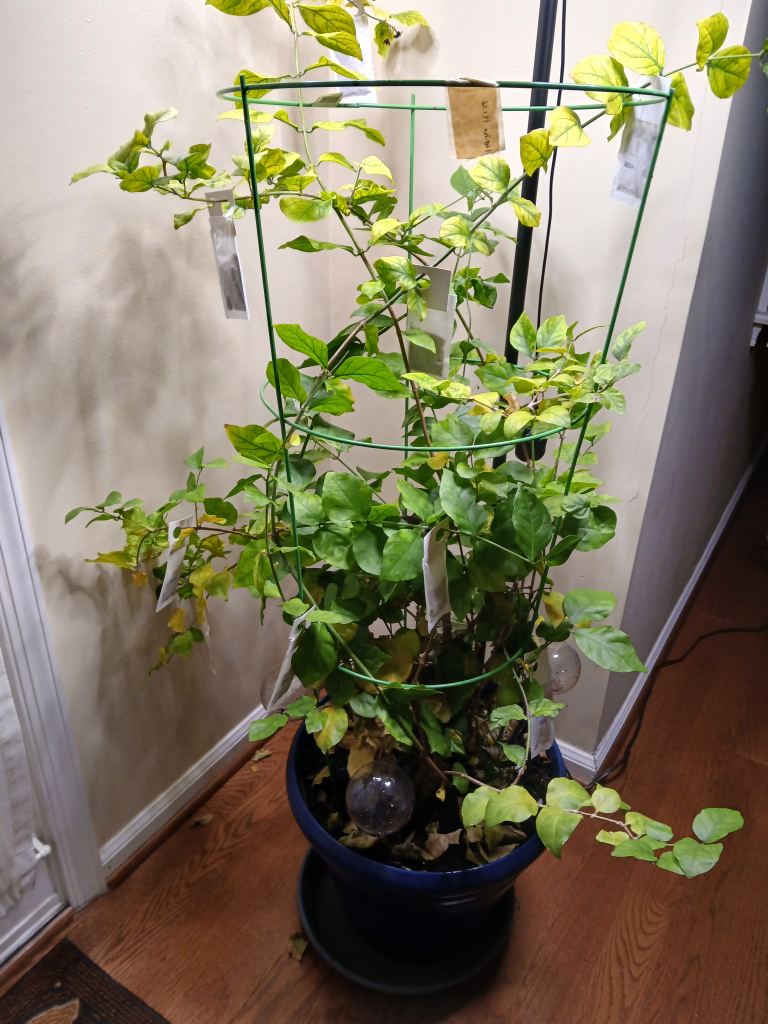
Figure 1. A sad jasmine bush. And it’s covered in mysterious sachets. Hm…
Oh no!
At first, I thought it might be a watering or nutritional issue. However, I discovered another problem upon closer inspection. Suspecting that something might be feeding on the plant’s precious bodily fluids, I broke off a piece of leaf to look at on the microscope and it was teeming… with mites! Here’s one on the move:
Video 1. Mite on a jasmine leaf.
I’m not an arachnologist, but these appear to be two-spotted spider mites. They are common pests which can cause damage to a wide variety of plant species [4]. I watched the mites for a few minutes. During this time, I observed them moving from place to place, occasionally stopping to feed on the leaf.
I wanted to get a close-up video of a mite feeding, but there was a slight problem. The light source on my microscope is not sufficient for this purpose. This is for two reasons:
- I wanted to look at mites sitting on top of a leaf. My sample is illuminated from below, so the light has to travel through the leaf before it reaches the mite, and eventually, my lens. This makes for a dim image.
- I needed to use an objective lens with a higher magnification. Higher objective lenses allow less light in. This also makes for a dim image.
The solution is simple: use a brighter light source. Fortunately, I have an LED bulb on hand which is much brighter than my usual light source. So, into the microscope it went!
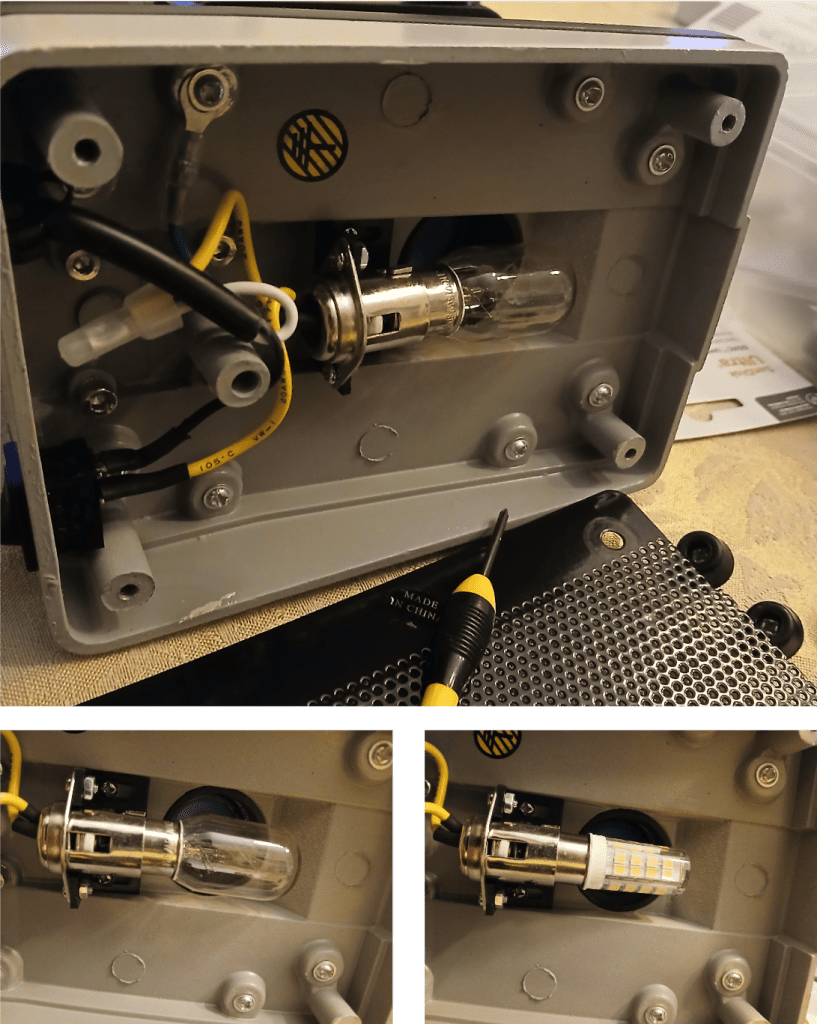
Figure 2. Top: Opening the bottom of the microscope to replace the light source. Bottom left: Original bulb before replacement. Bottom right: New LED light source. Much better!
I don’t normally use the LED light because it can be too bright (hurts my eyes) and has a harsh blue-ish color. However, it was quite useful in this case.
Right, then… behold! A spider mite feeding on a jasmine leaf!
Video 2. Spider mite feeding on a jasmine leaf.
If you look closely, you can see a bunch of… stuff inside the mite moving from side to side. What is it doing? According to this source [3], this material is located inside of the caudal caeca. The caudal caeca are two sac-like extensions of the gut that run along the sides of the mite’s body. They connect to each other in the center of the mite’s body, just behind the head. Contraction of muscles around the gut causes material to move rhythmically from one caecum to the other [3].
The little spots we can see moving back and forth are probably digestive cells. These specialized cells break off from the lining of the caeca. Then, they begin to ingest material from the surrounding gut contents as they float freely about. They are believed to accumulate unwanted digestive waste products. Consistent with this idea, they are eventually excreted as faecal material [3]. Pretty neat! In case my description was not colorful enough, Figure 1 from the source paper [3] is extremely helpful.
Fighting mites with mites
Given that these spider mites are damaging my jasmine plant, how can I stop them?? This plant is indoors (and it is winter, so it can’t go outside). Therefore, physical measures (spraying with a hose to remove the mites) and pesticides aren’t super practical. Removing the more heavily infested branches seems like a good place to start. A biological pest control solution might also also help. In this case, I have decided to fight the spider mites with yet more mites. Sure, that seems reasonable…
To be specific, I’ve employed the help of a predatory mite, Amblyseius andersoni, which actually eats spider mites. How convenient! They come in little sachets which resemble tea bags. You hang the sachets on the infested plant, and the Amblyseius mites crawl out of the little hole in the sachet and begin to feed on the spider mites. They might not finish off the spider mites completely, but I hope they will help me to keep them under control until I can get the plant outside (where I can use other control techniques if necessary).
As it happens, I received way more sachets than I ordered. So, rather than let them go to waste, I absolutely covered the jasmine bush with them (See Figure 1). This is probably overkill, but we’ll see.
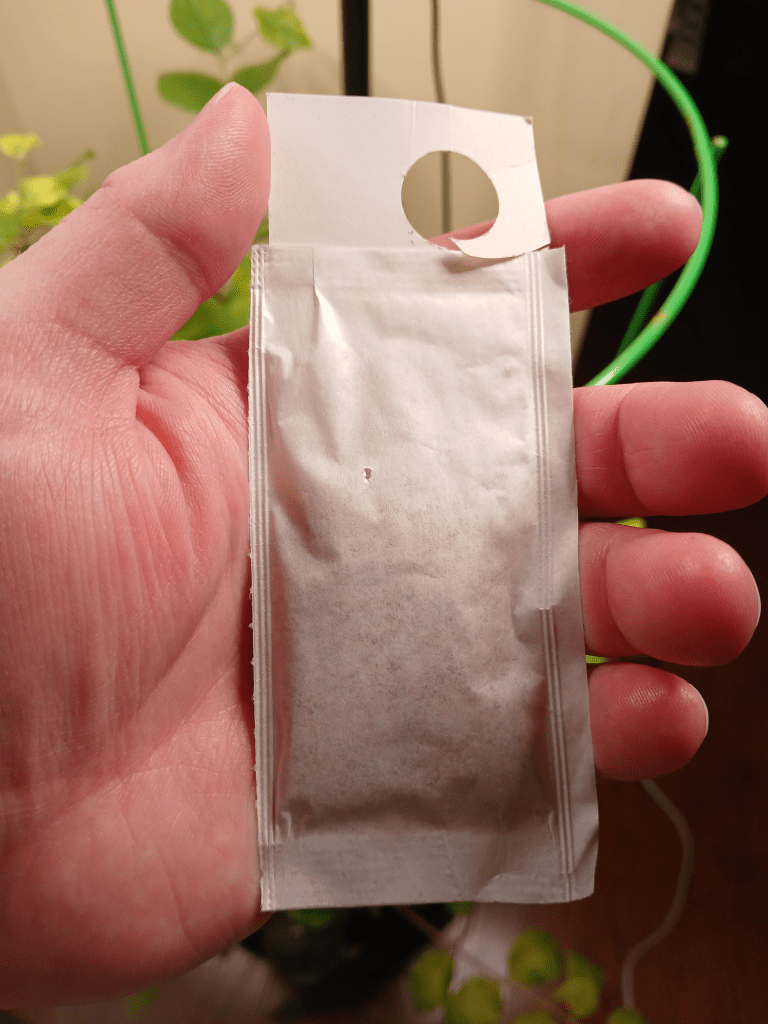
Figure 3. A sachet containing Amblyseius andersoni mites.
There are a number of different predatory mite species which are commercially available to help deal with spider mite infestations. I don’t know much about mites, but I chose A. andersoni (as opposed to, say, Persimilis mites) because it is supposed to be able to tolerate a wider range of temperature and humidity conditions [2][5]. This is necessary because our living space is fairly cool (~66˚ F) and dry (~40% RH), and predatory mites usually prefer higher temperature and humidity. To help matters, I’ve placed a humidifier next to the jasmine bush to make the mites more comfortable.
After receiving my A. andersoni in the mail, I decided to cut one of the sachets open to see if the mites were viable. I was pleased to see many live mites at several different life cycle stages. Mites are arachnids, meaning that they have 8 legs. However, the larval stage of A. andersoni only has 6 legs [1]. Here is one that I saw:
Video 3. A. andersoni larva, with 6 legs.
As the mites grow and molt, they develop their final pair of legs. This mite is at a later stage of the development process and has all 8 legs. They’re darn quick, too, and really tricky to film… I got lucky with this one!
Video 4. A more mature A. andersoni mite, now with all 8 legs. New-and-improved!
Here’s hoping our mite friends do the trick!
Works Cited
[1] Amblyseius andersoni. (2025). Koppert US.Retrieved February 15, 2026, from: https://www.koppertus.com/crop-protection/biological-pest-control/predatory-mites/amblyseius-andersoni/?utm_term=redirect
[2] Amblyseius andersoni – Generalist, Tolerates High Heats. (2026) NaturesGoodGuys. Retrieved February 15, 2026, from: https://www.naturesgoodguys.com/products/amblyseius-andersoni?variant=42422847111359
[3] Bensoussan, N., Zhurov, V., Yamakawa, S., O’Neil, C.H., Suzuki, T., Grbić, M., & Grbić, V. (2018). The Digestive System of the Two-Spotted Spider Mite, Tetranychus urticae Koch, in the Context of the Mite-Plant Interaction. Frontiers in Plant Science 9, 1206.
[4] Hazzard, R. (2022, July 28). Two-Spotted Spider Mite. UMassAmherst. Retrieved February 15, 2026, from: https://www.umass.edu/agriculture-food-environment/vegetable/fact-sheets/two-spotted-spider-mite
[5] Murray, M. (n.d.). Greenhouse Biocontrol in Utah. Utah State University. Retrieved February 15, 2026, from: https://digitalcommons.usu.edu/cgi/viewcontent.cgi?article=3332&context=extension_curall
CORRIGENDUM
In an earlier iteration of this blog post, Video 4 was the video shown here (which we will shall now call “Video 5”). This is NOT A. andersoni, but is instead an unidentified species of mite – likely included as food for A. andersoni in the sachets. Video 4 now shows A. andersoni. (The long legs are a hint).
Video 5. An unknown mite, which I mistakenly labelled A. andersoni…
 Plants for all
Leave a comment