I apologise for neglecting this blog for the past several months. Though I have been absent, please rest assured that there was plenty of plant stuff happening behind the scenes. Hopefully I can fill you in later.
Since my last installment, I actually moved to the UK for a job in my field! So I get to do even more plant stuff… but I can’t tell you about that yet.
What I can tell you about are these fine Arabidopsis specimens that I spotted growing in the sidewalk in Sunderland! At least I think they are… there are some lookalikes… but I’m fairly confident my ID is right.
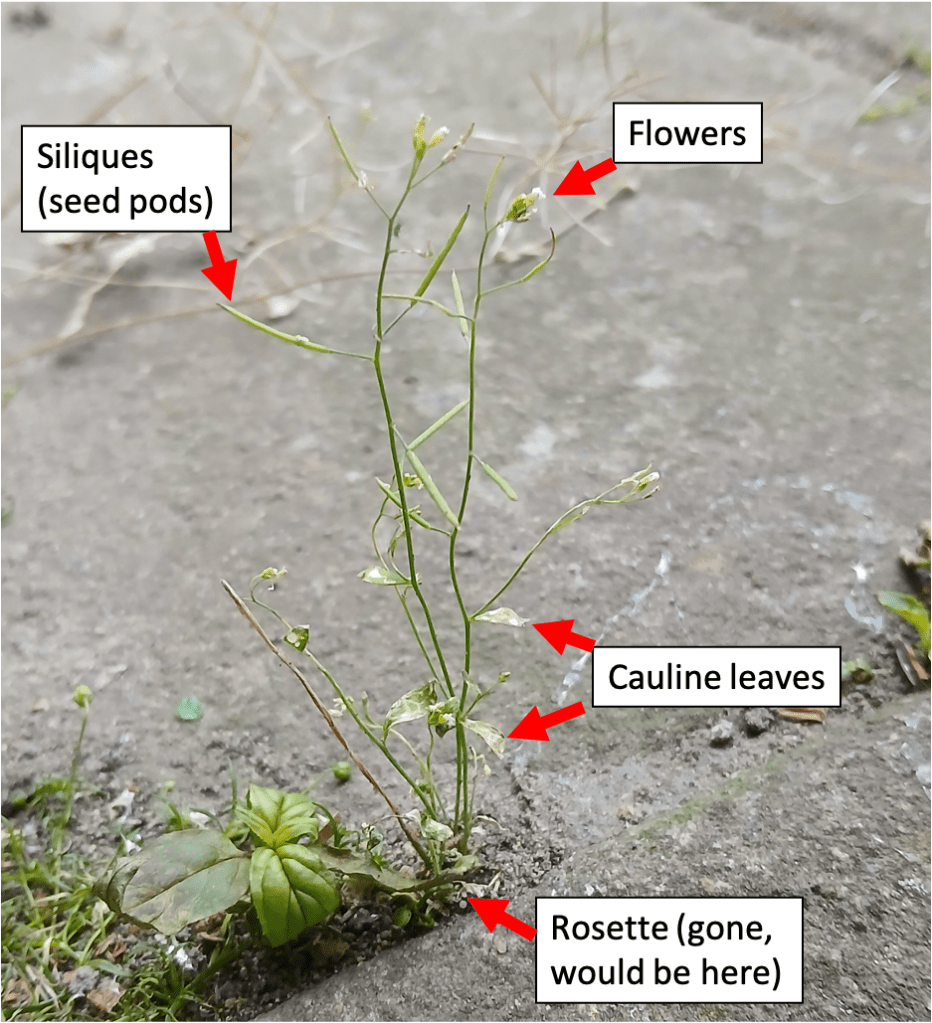
Figure 1. A wild Arabidopsis plant with some parts labelled. Arabidopsis grows by making a compact rosette of leaves. After a while, flower stalks grow upwards from the centre of the rosette. In this plant, the rosette is no longer visible. It is at a late stage in its life cycle: flowering and setting seed!
This plant might not be much to look at, but Arabidopsis thaliana is a very important species in plant research. Why? It is compact and has a short life cycle, meaning that it can be grown quickly and in very large numbers in a small amount of space – which makes it very practical for laboratory study (easy to have more replicates, yay!). It also has a small genome, making genetics studies easy. Furthermore, it is fairly closely related to crop species in the Brassicaceae family… think cabbage, broccoli, turnips, rapeseed, etc. This means that findings in Arabidopsis can allow us to make educated guesses about the biology of important crop species.
Here’s another Arabidopsis which is even further along in its development. It has no flowers at this stage, only siliques. The plant is beginning to die and dry out. Seeds mature as the siliques dry. Once the siliques are fully dry, the slightest force (wind/touch) causes the outer walls of the fruit to detach, allowing the tiny seeds inside to disperse.
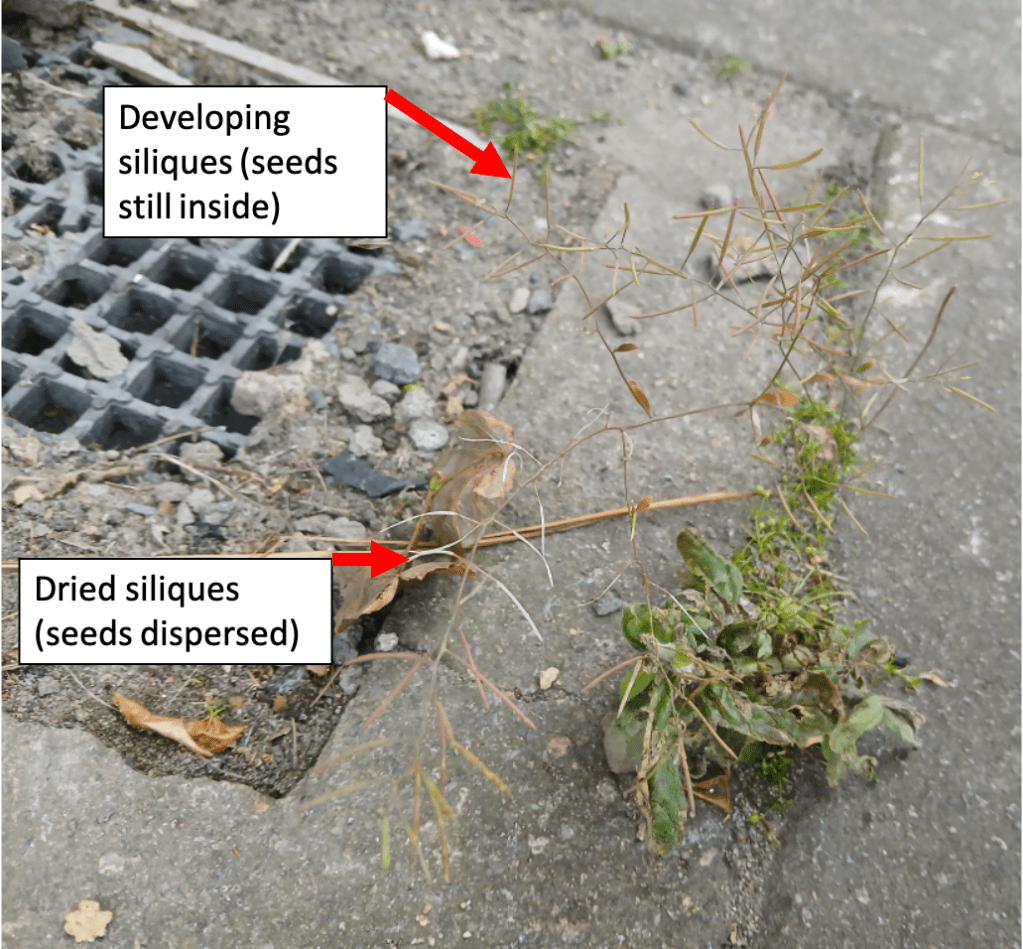
Figure 2. An Arabidopsis plant with more fully developed fruit. Developing siliques (which still contain seeds) are juicy and have some green color left. Mature, dry siliques open and drop their seeds, leaving the lighter-colored core of the fruit behind.
Some of these seeds will hopefully find a nice crevice in the sidewalk to settle down into… and the circle of life continues! Arabidopsis seeds are tiny, so they spread around pretty easily.
 Plants for all
Leave a comment