Greetings everyone! I hope you’re well. Welcome to this, the second post about this year’s container garden!
Today I will just give a brief overview of our attempts to grow two squash plants in containers. Don’t worry, there will be plenty of pictures. If anybody has tips on growing squash plants, please feel free to share them! I’m new to this, so I am hungry for advice.
As with the previous post, I must declare that most of these pictures were taken by my parents, since I am no longer around to take them myself. They have my eternal thanks for caring for the garden in my absence.
Honeynut squash
I’ve always wanted to try growing squash, but since our garden is limited to keeping plants in containers on the deck, I wasn’t sure if this would be practical. After some googling (since I don’t really know what I’m doing), I decided to try growing “Honeynut” squash. Basically, I really wanted to grow a butternut squash, but I had very limited space. I figured that since the honeynut squash plant produces smaller fruits, I might actually be able to get a few nice squashes, even if I have to keep my plants small.
We grew our honeynut squash plant in a 15-gallon container containing standard potting soil. Unlike the tomatoes and eggplants we talked about in the last blog post, there is generally no need to start squash plants indoors (at least in our climate). We direct-sowed our seed outdoors in late May. Other than regular watering and a single fertilizer dose about halfway through the growing season, we didn’t give it any other maintenance.
Growth started out fairly slow, but became increasingly rapid after about a month. We started see showy orange flowers in early- to mid-July. After flowering, the fruits rapidly grew to near full size, but they remained green for about a month before starting to change color (Figure 1).
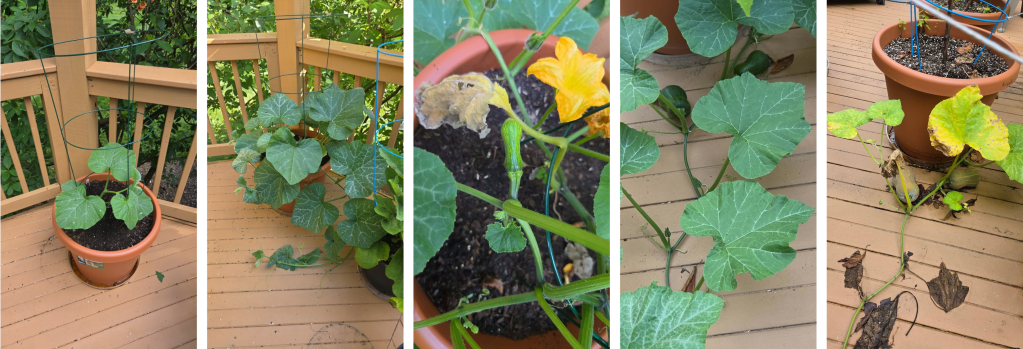
Figure 1. Our honeynut squash plant over the course of the summer season. These pictures were taken (in order) on: June 19, July 2, July 20, July 20 again, and August 31.
As the fruits started to ripen, the plant’s leaves started to die back (Figure 1, last image). As I am inexperienced with growing squash plants, I was initially worried that our plant was kaput. However, we did manage to get two nice squashes from this plant in the end (Figure 2)!
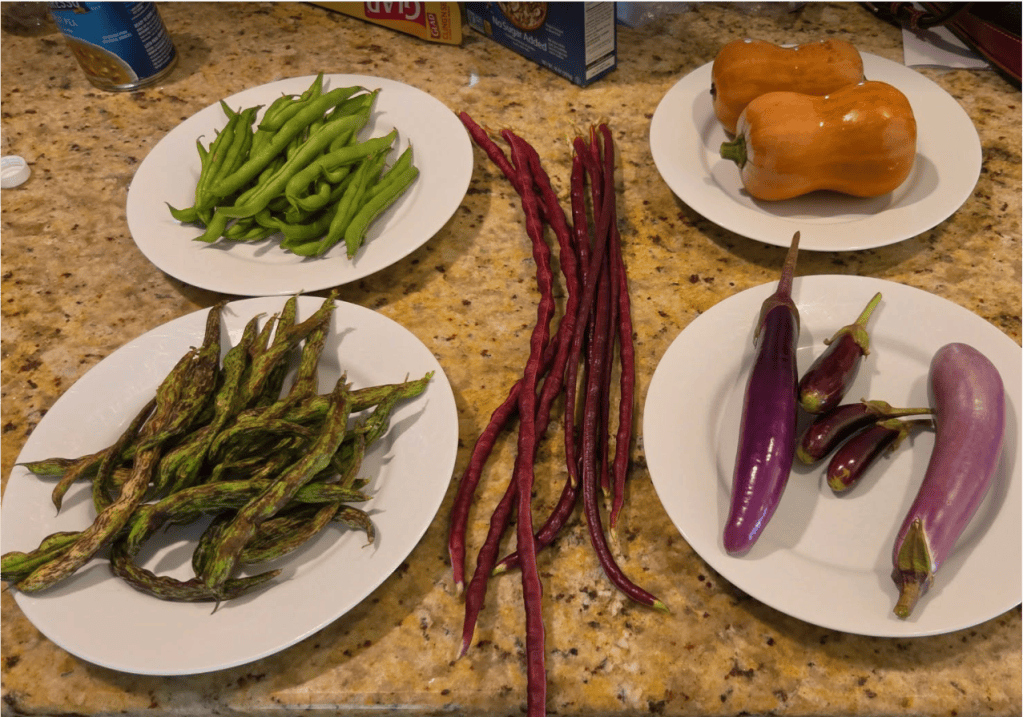
Figure 2. We got two squashes (top right)! (p.s. Look at all those beans… spoilers!)
I would definitely try growing this variety again. However, the yield was quite low (only two squashes). There are two main reasons I think the yield was as low as it was, and they are both fortunately straightforward to address:
First, our plant only had access to ~15 gallons of soil. This might sound like a lot, but winter squash plants get BIG – and can be seriously nutrient-hungry. Growing plants in an even larger container would give them more opportunity to expand and produce more fruit. More frequent fertilizing might also help to better meet their nutritional needs in a container setting.
Second, we did not pollinate our plant by hand. Why is this an issue? Well… Honeynut squash is actually a hybrid of two squash species: Cucurbita maxima (including pumpkins and their kin) and C. moschata (including butternut squash and their kin) [1]. Both parent species (and the honeynut itself) are monoecious, meaning that individual plants possess separate male and female flowers [2][3]. In order to get full-sized fruit, pollen from a male flower has to fertilize a female flower. Here’s the problem: If you have only one plant, and the male and female flowers appear at different times, then the female flowers will not be pollinated! There are a couple ways we can address this issue. For instance, growing more than one plant would increase the odds that male and female flowers would appear at the same time. Alternatively, you could try storing the pollen from a mature male flower, and using it later to hand-pollinate the female flowers. (Oh, I like that plan! That’s a good plan…).
Give me the Zucc!
In addition to the honeynut squash, we also tried growing zucchini (variety: “Black Beauty”) for the first time this year. Zucchini belong to the species Cucurbita pepo. As such, they are not the same species as the parents of the honeynut squash, but they do lie within the same genus.
Our zucchini plant was kept in a 10-gallon container, since I did not expect it to grow as large as the honeynut squash plant. Maybe it could have used a bigger pot…
As expected (given the descriptions on our seed packets!), our zucchini plant matured much more quickly than the honeynut squash (See Figure 3 below). We went from sowing seed in late May to mature fruit in about 1.5 months! I daresay if we wanted to, we could have fit two zucchini crops into a single growing season. Maybe next year…
As with the honeynut squash, our zucchini plant had a rather poor yield (only one mature fruit). It was, however, a prodigiously large fruit (Figure 3, last image). The reasons for our poor zucchini yield are probably the same as those for the poor yield of our honeynut squash: Our plant likely needed more soil, and we really should have hand-pollinated the flowers. We actually had loads of flowers, but only one of them bore us a mature fruit!
As always, if anybody with experience growing zucchini has ideas on how to improve yield, I am all ears!
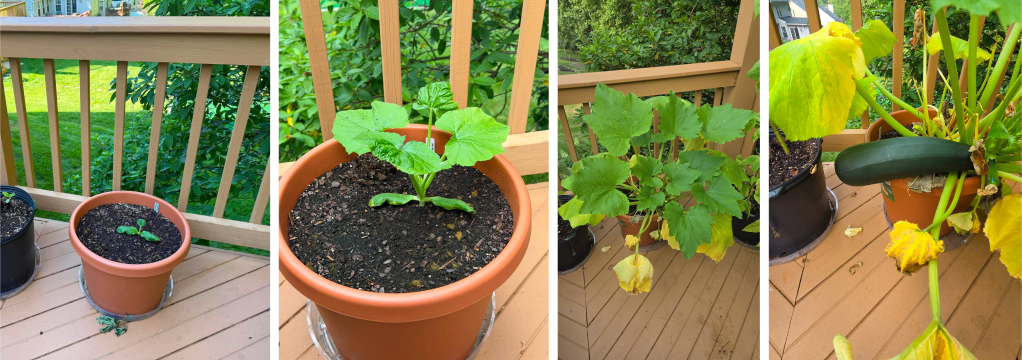
Figure 3. Our zucchini plant throughout this season. These images were taken on: May 31, June 10, June 19 (wow, look how much growth occurred in just 9 days!), and July 16. That was a seriously large zucchini. Fortunately, it did not yet have any large seeds, and my family found a culinary use for it.
Bonus: Sunflowers!
I ranted enough about sunflowers last year, so I’ll just give a brief photo montage of one of our plants from this year. This was an “American Giant Hybrid F1” plant growing in a 15-gallon container. It got a bit over 8 feet tall and gave us a decent-sized seed head. I think our “Arikara” sunflower from last year was roughly the same height, but I don’t remember the seed head being quite so large.
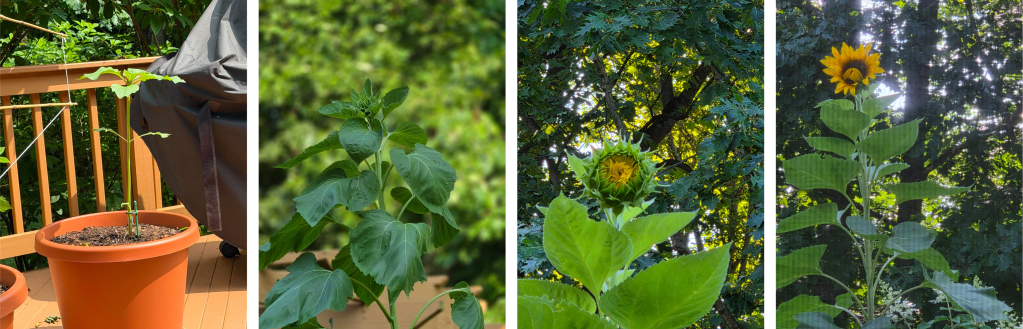
Figure 4. Our “American Giant Hybrid F1” sunflower at different growth stages. The left-hand image shows the plant as a seedling, at just a couple weeks old. The next three pictures show how the flower head developed from July 22 to August 1.
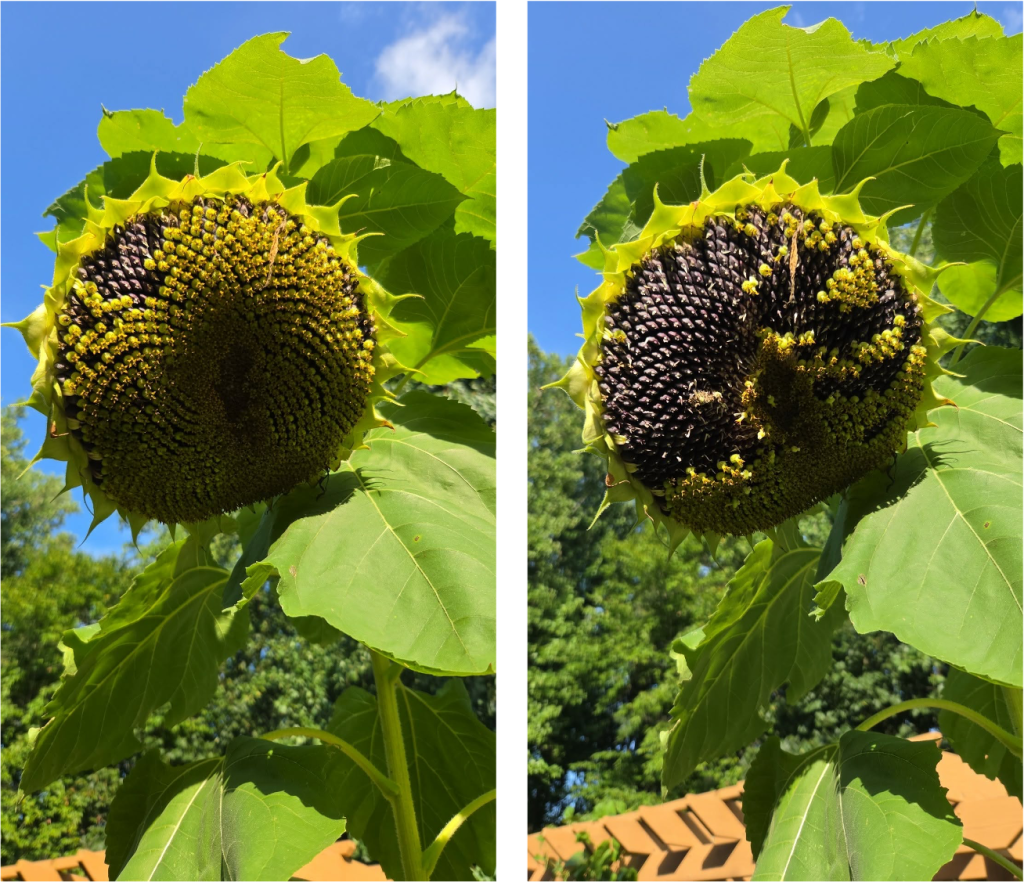
Figure 5. The seed head from the same sunflower plant on August 28, before (left) and after (right) knocking off the remains of the flowers to expose the seeds below.
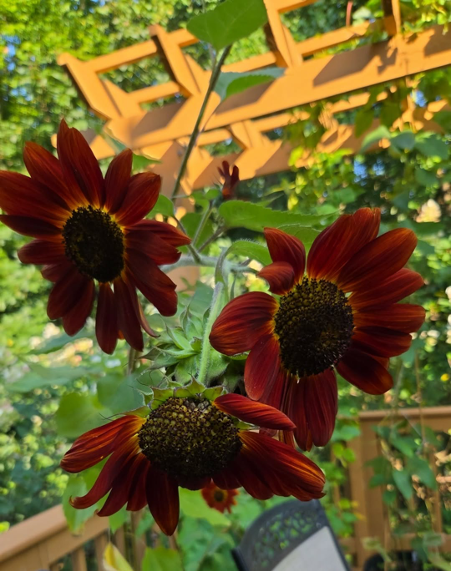
Figure 6. I couldn’t resist growing some “Chocolate Cherry” sunflowers this year, either!
Works cited:
[1] Hultengren, R.L., Wyatt, L., & Mazourek, M. (2016). A Suite of High-quality Butternut Squash. HortScience 51(11), 1435-1437.
[2] Missouri Botanical Garden. (n.d.) Cucurbita moschata. Plant Finder. Retrieved September 26, 2026, from: https://plantfinder.mobot.org/PlantFinderDetails.aspx?kempercode=e451
[3] Missouri Botanical Garden. (n.d.) Cucurbita maxima. Plant Finder. Retrieved September 26, 2026, from: https://plantfinder.mobot.org/PlantFinderDetails.aspx?taxonid=292206&isprofile=0&cv=5&mobile=0&source=return&index=2


Leave a comment